

Does Makeup Go Into Your Blood
Where Does All the Skin Care Go?
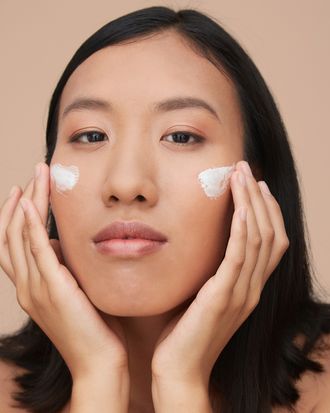
Photo: Pablo Croatto/Westend61/Getty Images
Perhaps yous've come beyond this oftentimes-cited statistic: sixty percentage of skin care absorbs into your bloodstream. (If y'all inquire Gwyneth Paltrow, that number shoots upwardly to 70 percent.) Hard data says otherwise — there'due south no way to quantify exactly how much skin care gets "soaked" upward by your blood. There is not, in fact, a cocktail of vital fluids and vitamin C serum coursing through your veins as nosotros speak.
But where does all the peel intendance get?
Once applied, does information technology sit on elevation of your peel? Does information technology "sink into your pores," as the beauty bloggers say? And and so what — does it pool at the bottom of the pore? Can information technology become by the bottom of the pore? If and so, is there skin care floating in your lymphatic fluid at this very 2nd? Does whatsoever really make information technology to your blood?
I took my questions to the experts and the answer, to all of the to a higher place, is yes. Depending on the ingredient, pare care can go any number of places: Pores! Blood! Breast tissue! More often than not, though, it goes nowhere.
"The skin is the largest organ in the torso. Its job is to protect you lot from external agents that might crusade harm, and it does a very proficient job at that," Ron Robinson, corrective chemist and founder of BeautyStat Cosmetics, tells the Cut. Pare has what Robinson calls an "armor" in identify to defend confronting "potential aggressors" like leaner and beauty products. That would exist the pare bulwark, or the stratum corneum.
The stratum corneum has lots of microscopic moving parts: the microbiome, the acid mantle, the lipid barrier, a layer of expressionless skin cells sometimes compared to a brick wall. They come up together to form a waxy, water-repellent shield of fat acids, sebum, and ceramides, which seals the pare's natural moisture in and keeps external wet out. This is a skillful thing; information technology'due south why you lot tin luxuriate in the occasional bathroom and still pb a long, non-waterlogged life. Merely information technology's likewise a bummer, because skin care consists of a lot of water.
A quick browse of the ingredient labels in your bath chiffonier can confirm: Water is typically the top-listed ingredient. Both the Dr. Barbara Sturm Hyaluronic Acid Serum ($300) and the Vichy Hyaluronic Acid Serum ($xx) are mostly water, and effectually i percent hyaluronic acrid. Reports gauge h2o-based products can be anywhere from 70 percent to xc percent water, because water is an effective way to deliquesce and dilute active ingredients and also the cheapest way to fill up a bottle. An engineer for peel-intendance manufacturer Amway once described the creation process to the Atlantic by saying, "You put h2o in a tank. You lot stir the stuff in[to] the tank." That stuff is largely oil, but since oil and water don't mix, that stuff is also emulsifiers, which alloy the two so skin intendance doesn't go the manner of balsamic vinaigrette.
Oil- and wax-based elixirs — the exceptions to the water dominion — can't absorb past the skin's surface, either. These molecules are simply too big. Oils specifically "have these huge lipid complexes that are basically, you know, congealed," says Greg Altman, Ph.D., the founder of chemistry company Evolved past Nature and beauty brand Silk Therapeutics. "They make the peel feel great, just the chance that they're going into the body is, in my stance, slim." Waxes and balms accept an even slimmer chance of breaking through the barrier, as they are "enormous." Silicones have almost no promise of absorption at all; they coat the pare in what'due south essentially a plastic pic — the Saran Wrap of skin care.
That'southward non to say some of these not-penetrative ingredients aren't lovely. "They tin can seal the peel and requite a hydrating event, and when you lot practise that, and so everything happening underneath is very happy," explains Dr. Altman. The whole signal of skin care, actually, is to nourish the pare barrier. Once that's good, the skin's "normal regenerative processes take over," the chemist says. It cocky-moisturizes (via sebum), self-exfoliates (via a shedding process known equally desquamation), self-protects (via the acid mantle, which neutralizes invading leaner and pathogens), and cocky-heals.
"But my skin intendance feels like it'southward 'sinking in,'" you may protest, as I did. This is an illusion. That sinking-in sensation — moisturizer melting into your confront, going from wet to less-wet in minutes — is just air-drying in action. Sure, some of the external hydration products provide is captivated into the skin bulwark (did y'all know expressionless skin cells hoard wet? They practise!), only the majority of water and water-soluble ingredients, like fragrance and essential oils, start evaporating into thin air equally soon as they're applied.
The rest are "essentially washed off," per Dr. Altman, although oils and waxes tin delay this effect. "Even if y'all're not washing your face, throughout the twenty-four hour period, you're sweating, your skin is breathing, at that place's humidity in the air, ingredients are getting diluted." You besides lose expressionless skin cells (the very same ones you applied skin-care to) at a rate of nearly twoscore,000 per mean solar day. "As you shed expressionless skin cells you lot are shedding ingredients from your moisturizer that didn't penetrate the skin," Perry Romanowski, a cosmetic chemist and founder of The Beauty Brains, tells the Cutting. "The ingredients are 'lurking' wherever your dead skin cells are lurking." The air, your clothes, grit bunnies. (Very dewy dust bunnies.)
Even ingredients that naturally occur within the skin are destined for a surface-level existence. Collagen protein, for example, lives in the dermis, a lower layer of the skin — only topical versions can't magically woosh downwardly to the dermis. "Protein that is larger than 50 kilodaltons has no chance of ever penetrating the skin," Dr. Altman says. The same goes for hyaluronic acid, or HA, another natural dermis-dweller. "In that location are no hyaluronic acids that can actually transport and penetrate the skin," he states. "That is why we have the world of injectable dermal fillers." (HA absorbs up to i,000 times its weight in water, and since cosmetic-form HA is a powder that needs to be dissolved in h2o, HA absorbs a portion of its potential h2o weight from within its very own skin-care formulation. Past the fourth dimension those HA molecules hit your water-resistant skin barrier, they're already heavy with —sigh — h2o. Low molecular weight HA can slightly penetrate, just most of it doesn't.)
The pare-intendance savvy have found a way around this, though. According to the chemist, "The reality is if yous want to open the skin, yous have to decrease the pH of the stratum corneum, which makes the peel more than porous." You can do it with exfoliators, like acids and chemical peels, or y'all can practice information technology with energy, like lasers. Formulators even comprise ingredients that interruption down the barrier, like alcohol, to assist in product penetration, which is non necessarily advisable. "We don't put things in pores," says an exasperated-sounding Dr. Altman. They are, he points out, approachable channels for sweat and sebum. "Whatsoever fourth dimension we put things in pores, we end up in trouble. That'south where we get acne."
Notwithstanding, if an ingredient checks all the right boxes — hydrophilic and lipophilic properties, a depression molecular weight — it tin safely sneak past the stratum corneum without clogging the pores. Vitamin C is one such substance; information technology travels to the dermis (and maybe even deeper) to stimulate natural collagen production. Epidermal Growth Factor (EGF) supposedly absorbs this way, besides. "We just discovered a silk molecule that is of the correct size that has the ability to both penetrate the skin and cause pare cells to produce more collagen," adds Dr. Altman. It's chosen Activated Silk 27C. (A synthesized version of EGF from infant foreskin was the star ingredient in the "penis facial" loved by the Ocean's Eight cast). The take hold of: If any of these are ensconced in silicone, they probably won't pierce the surface.
Finally, there are the beauty ingredients that beat all the odds; that infiltrate both the circulatory and lymphatic systems. (Dr. Altman describes the two as unlike lanes in the same clandestine tunnel where, "unlike Boston Logan," irresolute lanes is immune. Whatsoever ends up in the blood ends up in the lymph and vice versa.)
To achieve this feat of absorption, molecules demand to be very small, oil-soluble (to break through the skin barrier), and water-soluble (to break through the blood barrier). This does not brand them whatever amend at skin care. "The goal is to create products that work on the pare's surface, not to absorb into your claret," as Robinson puts it. Specially because the Food & Drug Administration classifies blood-penetrating ingredients as "drugs."
Hither's where pare care gets a little suspicious. "The 1 regulation that the FDA does have is, yous cannot make structural or functional claims with a particular ingredient," Dr. Altman says. "And so let's merely say you have an ingredient in your formula that does penetrate, you would be in violation of FDA regulations if yous actually said that." This is likely because salable "drugs" demand to ensure consumer safety … and no one really knows what blood-penetrating beauty ingredients do one time they're in the body. Take chemical sunscreens. The FDA recently found that 6 of them — avobenzone, oxybenzone, octocrylene, homosalate, octisalate, and octinoxate — not merely absorb directly into the bloodstream, but they do so at "toxic" levels. What does that mean for human being health? No idea! "Further studies" are needed "to determine the clinical significance of these findings."
Other claret-surfing skin-care ingredients include retinol (it's listed on California's Prop 65 for potential "reproductive toxicity" for this reason), sodium lauryl sulphate (or SLS, found in cleansers), and polycyclic aromatic hydrocarbons (aka PAHs, possible contaminants in petrolatum and mineral oil and suspected carcinogens). A study from 2009 found over 200 boosted chemicals in infants' umbilical cord claret, some from beauty products presumably worn by their mothers.
"Some of these chemical molecules actually look similar hormones, then the blood system distributes them throughout the torso," Dr. Altman elaborates. Parabens (a preservative), phthalates (maybe hidden in fragrance), butoxyethanol and methoxydiglycol (both glycol ethers), and the aforementioned octinoxate all fall into this category. Studies testify they may mess with fertility and sexual office, and even contribute to hormone-related cancers similar breast cancer. Parabens specifically have been found in breast tissue and breast tumors. "Recent information points to parabens' potential to cause harm," Robinson confirms, but again, "more research is needed" to decide the extent of said damage. BreastCancer.org recommends avoiding parabens and phthalates altogether, just in case.
The real questions, Dr. Altman says, are these: Where does all the skin care go subsequently it'southward in the body? Is it filtered out by the liver, only to be reabsorbed with the next nighttime routine? Could chronic chemical exposure from cosmetics have long-term health implications? "In truth, this is not an area in which scientists have done much enquiry," Romanowski agrees. "The topic of the life wheel of ingredients … has not been investigated."
While the world waits for answers, find comfort in the fact that most skin-care will vanish into thin air earlier it ever makes it to your veins.
Source: https://www.thecut.com/2020/01/what-happens-to-skin-care-after-you-apply-it.html
Posted by: cookdagothead.blogspot.com
0 Response to "Does Makeup Go Into Your Blood"
Post a Comment