

How To Draw Cave Art Animals
Cartoon Anthropomorphic Animals
52,095 views
Introduction
Anthropomorphic animals are animals with human-like characteristics. They're commonly referred to as "furries" or "kemono." The genre has been gaining a rapid increase of attention in recent years, and is frequently found in movies, anime, cartoons, and writing. The power to draw these creatures can increase an artist's versatility for grapheme creation in their works. Fantasy based settings tend to specially brand utilise of this, with species such as "Fauna men" being a common trope.
The broad range of animals to cull from when designing your anthro gives nascence to vast possibilities for the character's structure and build. Be sure to research real life species kickoff to examine their body shape and features. Picking out wear and even hairstyles which may reflect on the human cultures institute in the geography that the animals live in tin can be a fun bonus.
In this guide, I'll be sharing with you some tutorials I've made which provide useful tips and tricks when drawing furries. Nearly of these tutorials can besides be applied to feral structured brute art, in the effect that you're not as well addicted of their anthro counterpart.
Anthro Legs
Unlike humans who have one pivot point, animals accept two, resulting in a different anatomical structure. Depending on how animal-like you want your furry to be, this can be useful in adding an additional chemical element of realism to their character. Besides, don't forget! The body is a three dimensional form. Exist sure to incorporate a sense of depth, rather than a flat figure.
Different species will take varying thickness of legs and body. For example, heavy typhoon horses or elephants take a sturdy build, while coyotes or deer accept slim, active legs. Go on in heed how muscular your grapheme and species is, as the legs are a neat opportunity for showing personality and mode.
Fluid, rounded shapes are about common in existent animals. Combine circles, ovals, and curves to reach an appealing form. If y'all're going for a more stylistic appearance, however, the heaven's the limit.
Anthro Hands
Anthropomorphic hands can range drastically in style and be either significantly different from human hands, or quite like. For this tutorial I've gone with a more man-like case, featuring enlarged finger tips to allow for hand pads.
If yous're feeling lost on how to stylize your own anthro hands, endeavour looking up photographs of easily belonging to primates as they're different from slender man fingers and can characteristic odd shapes.
> Footstep One :: Start elementary. Break down your hand into a rounded foursquare and a line for where the eye of the wrist volition be.
---
> Step Two :: Add together a box for where the thumb will go and sketch the rough layout of the fingers. Notation that fingers don't all accept the same acme, so angling your box for where they'll go tin can provide you with a visual reminder to give them height variety.
I've also made four circles at the base on my fingers box, to point where each finger volition sprout from.
---
> Stride 3 :: Starting from the base of operations of each finger circle and drawing upwardly to the meridian of the finger box, I brand the individual fingers.
> Step Four :: Draw ovals and circles for the manus pads. Connect the wrist to the hand, following the same curve as the center wrist line that we drew in Footstep One.
---
> Step 5 :: Get sketching to farther mankind out your hand shape and add details. I've too incorporated small claws.
---
> Step Half dozen :: Finish off your sketch with a clean layer of lineart, coloring, shading, and highlights. Don't forget that this is a three dimensional form, so rounded shadows and highlights can assistance in this visually.
Drawing a Canine Head
Dogs are one of the most popular species of anthropomorphic animals, then I'll be doing a step by pace tutorial on how to describe a doberman's head. This aforementioned method can be applied to most any canine, or even virtually species with some pocket-sized adjustments such as muzzle length. While drawing the caput, consider all parts moving with some degree of connection amidst themselves.
> Footstep 1 :: Start with a circle. Then, from the edge of a circle, add a rounded box shape. This box will later be your muzzle, and so pay attention to its length to insure it isn't too long or too short for your species. As always, referencing real life photos of animals tin can significantly aid you in getting proper proportions.
---
> Pace Two :: Calculation the optics and nose. Think of the eyes as boxes, with triangles added to each end. Y'all can achieve various expressions depending on how you angle the eyes, only for this tutorial we'll be going with a sly, coincidental expression. For this I have the eyes angled upward. The nose then gets added to the stop of the muzzle, with a bend.
---
> Pace Three :: The cheeks connect from the ends of each eye, to the muzzle in one round motility. Information technology may help to draw a circle first at that place, to ameliorate envision the space. Once over again, the head is three dimensional, so don't make those cheeks too flat or straight!
The eyebrows get added in on top of each eyelid past drawing a "Ying-Yang half" connected to the eyelid.
Afterwards that is adding your mouth. Showtime right before your middle box line starts to curve upwards, and finish the oral cavity nigh where the pupil of the eye volition exist to attain a smile. Curves are your best friend!
> Step 4 :: Time to add the ears! Recollect of a three dimensional cone shape, and add information technology to each side of the head. A helpful tip is that both ears will be virtually the aforementioned tiptop, even though 1 is going on the other side of quarter view head. You can check to make sure they're the same height to grabbing your ruler tool (CTRL+R) and moving the top ruler downwardly to measure.
> Step Five :: Adding the neck is easier when you think of it like a diamond shape or square. Connect that foursquare shape with a curve that comes downwards from the dorsum of the head, and makes another foursquare. Sort of like two squares overlapping each other.
---
> Footstep Six :: Time to ascertain the collar os and breast dimensions! Make some other diamond/foursquare just below the middle of your first. Then draw a line to connect the two at the bottom.
> Step Seven :: We're almost done with the sketch, just got to make clean it upwardly by erasing whatever extra lines.
---
> Footstep Eight :: The sketch is done! Round out of the edges of it and so it flows smoothly, and tidy things up with some make clean lineart.
A tip for doing lineart on tiptop of your sketch is to plough on Layer Colour for your sketch found under the "Effect" tab on your right side console. Make a new layer. Then practice your clean lineart on top in black. The sketch being in a dissimilar color makes it easier to see your concluding lineart.
Once the make clean lines are done, simply plow off your sketch layer and wow! Y'all're left with pretty final line work.
I utilize the G-Pen with stabilization and pen pressure turned on for piece of cake command of line width and smoothen lines.
Consider what colors your character or animal species has before you begin the coloring process and make a color pallet. Dobermans have a diverseness of unlike coat colors to choose from, above I've made very basic color pallets for three different varieties.
I made these color pallets by pulling up real life photos of the dog brood and using my Color Selector tool to catch colors directly from the dogs.
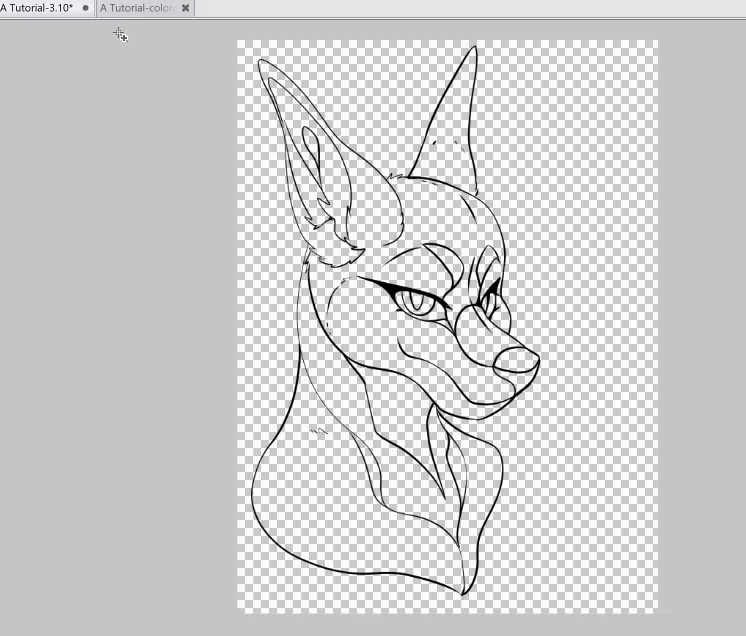
Having easy admission to your references and color pallets for quick visibility, without hindering your drawing process or cluttering your screen, is vital for a smooth piece of work period. To practice this I open my references and color pallets in a new tab, drag the tab down onto my main canvass, resize the tab, and motility it to an easy to come across spot on the screen. Y'all can even practice this for multiple tabs at a time.
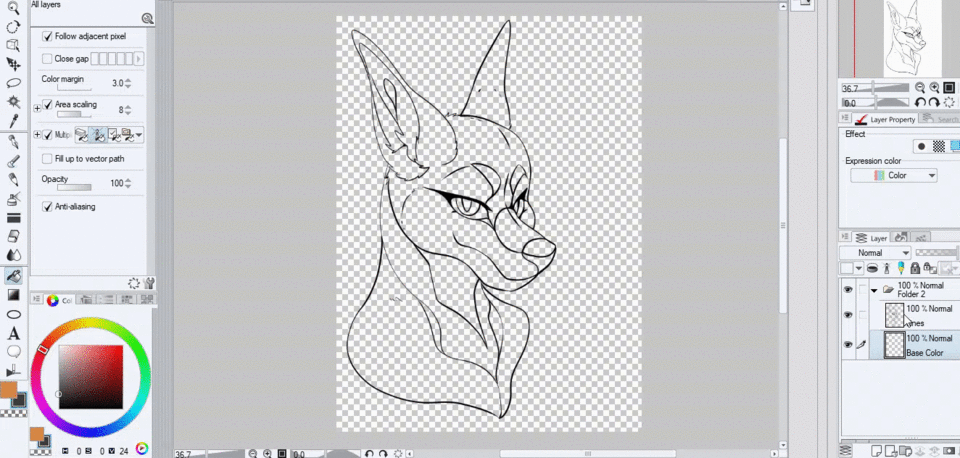
> Step Nine :: Coloring. To get an instant base layer of colour under your lineart, set your lineart layer equally "Reference Layer" by clicking the lighthouse looking icon in a higher place your layer menu. Make a new layer for color below it. Select your Magic Wand tool now, and click anywhere outside of your lineart. Inverse this selection on the minor popup panel, and so select "Fill."
Want to chop-chop color a sketch, or lineart which contains gaps? Just enable "Close Gap" on your Selection Wand and conform that setting for how large your gaps are.
> Step Nine Connected :: With the base layer of color done, get in and colour the additional fur patterns. If your lineart layer is ready to "Reference Layer" as described in the above tip, coloring in lineart is quick and like shooting fish in a barrel regardless of what layer you're on.
> Step 10 :: Set your shadow layer to "Multiply." Clip this layer to your base colour layer. When painting shadows, exist sure to keep in mind where your light source is located. I prefer to use watercolor styled brushes for this step, every bit it gives a fur-similar event with minimum endeavour. Dobermans take very brusk, glossy fur, and so it's not necessary to get into excess detail painting fur for this brood.
The colour of shadow you use can vary depending on the surrounding light or scene. For this elementary headshot, however, I've just used a bones blue to stand out against the dark grey of the coat colour.
> Footstep Eleven :: Set new highlight layer to "Overlay." Clip this layer to your base of operations colour layer. With the same watercolor based brush I used for painting shadows, I now become in and pigment the bones highlights using a warm gold color.
> Step Twelve :: Time to add gloss! Cyan or lite yellow tends to work best for bright pops of colour. I prefer to avoid using solid white, as information technology doesn't provide enough depth.
This is the brush I utilize for most all of my gloss effects;
> Step Thirteen :: This footstep is optional but helps to add appeal and depth to the character.
For the final touches, I like to have my "Slope Tool" assail "Groundwork to Transparent" mode and in a new layer set to "Linear low-cal" practice additional lighting. Be certain to clip this new boosted lighting layer to your base of operations color layer. Do ane gradient stroke with a warm color from the top where your light source is coming from, and one stroke in a different, ambience lightning coloring, from the bottom.
Painting Fur
When cartoon nearly any mammal, chances are you'll demand to create some degree of fur. For this next tutorial, I'll be sharing my step by pace guide on how to do this. As e'er, be sure to pull up a reference photograph of whatever your fauna is so yous tin gauge the density, color, pattern, length, and straightness of their fur. Some species will take very wavy fur while others will have a more straight and slick appearance.
> Step One :: Start with a sketch. For this tutorial, I'll exist painting the fur for a canine tail. Every bit I'll be painting the fur rather than jail cell shading, the sketch can be rough since information technology'll only become painted over in the end.
---
> Step 2 , Three , Iv , and V :: As nosotros did with the Doberman Head tutorial in step ix, information technology's time to lay out the base colors of our tail.
Set your sketch layer as "Reference Layer" past clicking the lighthouse looking icon above your layer carte. Make a new layer for color below information technology. Select your "Magic Wand" tool, brand sure that "Fill Gap" is enabled if you have a crude sketch like I practice with lots of gaps in it. Click anywhere on the sheet outside of your lineart, inverse that option, and then fill.
> Pace Six :: Information technology's now time to establish base shading and highlights! Make a new layer and clip it to your tail base coloring below.
> Footstep Seven :: Grab whatsoever watercolor castor tool. For all tutorials in this guide, I utilize the "Transparent Watercolor" castor which is plant already in Clip Studio. I adjust the settings on it as needed, but start primarily with the ones seen in the prototype to a higher place. (The castor size should be adjusted depending on how big your sail is and what you're painting.)
---
> Step Eight :: I become to work painting both the general highlights and shadows. Notice how the brush gives a textured, fur-like result, rather than being a completely smooth surface.
> Step Nine :: Brainstorm adding shadows for where general fur strands will fall. Empathise that fur has specific directions that information technology falls in, which vary depending on the private body parts on the animal. For the tail, the fur more often than not goes in a down direction. Longer fur has more room for curves, while shorter fur will oftentimes exist straighter.
---
> Step Ten :: Using a lighter colour, define the fur strands farther by going over top of the shadows with your highlights. The highlighted potion will be found on the edges of the individual fur strands, the base of the fur strands should become darker equally it blends in.
> Step 11 :: Make your watercolor brush smaller and brainstorm touching up the fur more past defining the edges of strands with your shadows and highlights. I suggest using your Colour Picker tool to hands grab colors currently present. Darken shadows if needed.
You can cease with Step Eleven if you lot want more realistic fur, or go onto Step Twelve for more vibrant semi-realism often seen in anime-style anthros.
---
> Step Twelve :: Adding gloss. Using a lite cyan color to contrast against the brown fur, I use this castor again (as seen in step Twelve of the doberman tutorial) to make the figure pop out by adding glossy effects.
> Step Thirteen through Fourteen :: Make 3 new layers. Prune new layers to your painted fur layer, and set two of the new layers to "Overlay" and i of the new layers to "Multiply."
> Step Fourteen through Fifteen :: Using a cyan color, I go in with a polish rounded brush and add together additional lighting effects to the top of the fur on my new highlights Overlay layer. I also get in with a light crimson brush color and add rim lights to the bottom of the fur on my 2d new Overlay layer.
On my multiply layer, I select a muted redish color and bring out some of those shadows where needed.
Once this stride is done, your fur is complete!
---
Cheers all for reading, and I promise you picked up some tips, tricks, and ideas to contain into your own work!
Users who liked this post

Source: https://tips.clip-studio.com/en-us/articles/2393
Posted by: cookdagothead.blogspot.com
0 Response to "How To Draw Cave Art Animals"
Post a Comment